
Python super() function allows us to refer to the parent class explicitly. It’s useful in case of inheritance where we want to call super class functions.
Python super
To understand about python super function, you have to know about Python Inheritance. In Python Inheritance, the subclasses inherit from the superclass. Python super() function allows us to refer the superclass implicitly. So, Python super makes our task easier and comfortable. While referring the superclass from the subclass, we don’t need to write the name of superclass explicitly. In the following sections, we will discuss python super function.
Python super function example
At first, just look at the following code we used in our Python Inheritance tutorial. In that example code, the superclass was Person and the subclass was Student. So the code is shown below.
class Person:
    # initializing the variables
    name = ""
    age = 0

    # defining constructor
    def __init__(self, person_name, person_age):
        self.name = person_name
        self.age = person_age

        # defining class methods

    def show_name(self):
        print(self.name)

    def show_age(self):
        print(self.age)


# definition of subclass starts here
class Student(Person):
    studentId = ""

    def __init__(self, student_name, student_age, student_id):
        Person.__init__(self, student_name, student_age)
        self.studentId = student_id

    def get_id(self):
        return self.studentId  # returns the value of student id


# end of subclass definition


# Create an object of the superclass
person1 = Person("Richard", 23)
# call member methods of the objects
person1.show_age()
# Create an object of the subclass
student1 = Student("Max", 22, "102")
print(student1.get_id())
student1.show_name()
In the above example, we have called parent class function as:
Person.__init__(self, student_name, student_age)
We can replace this with python super function call as below.
super().__init__(student_name, student_age)
The output will remain the same in both the cases, as shown in the below image. 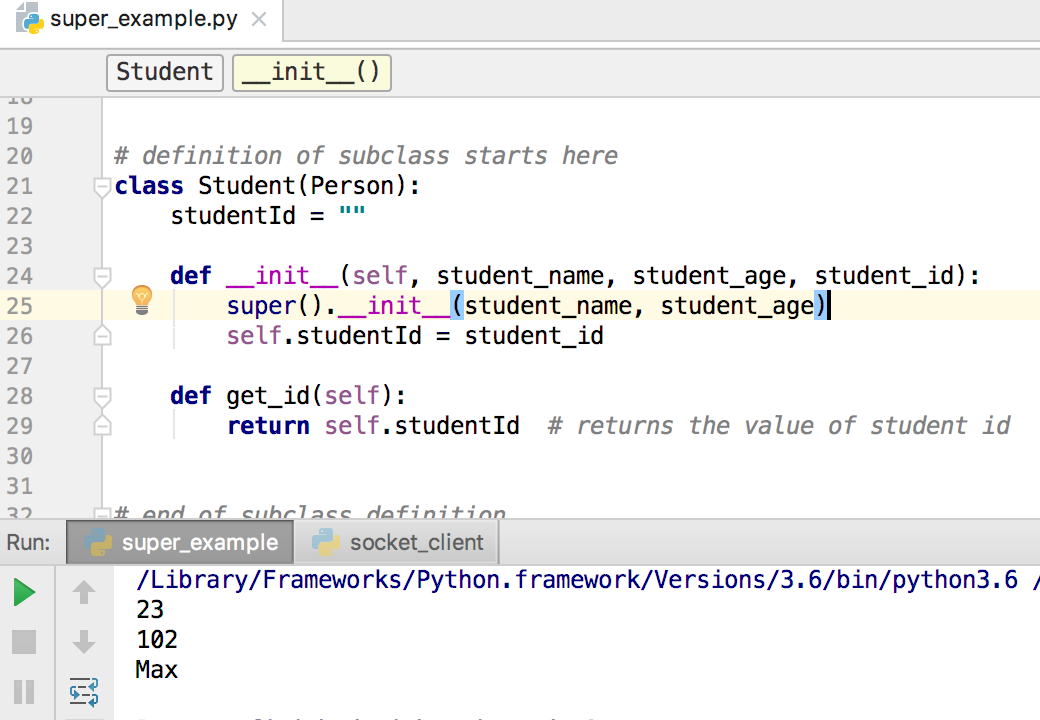
Python 3 super
Note that the above syntax is for python 3 super function. If you are on python 2.x versions, then it’s slightly different and you will have to do the following changes:
class Person(object):
...
        super(Student, self).__init__(student_name, student_age)
The first change is to have object as the base class for Person. It’s required to use the super function in Python 2.x versions. Otherwise, you will get the following error.
Traceback (most recent call last):
  File "super_example.py", line 40, in <module>
    student1 = Student("Max", 22, "102")
  File "super_example.py", line 25, in __init__
    super(Student, self).__init__(student_name, student_age)
TypeError: must be type, not classobj
The second change in the syntax of the super function itself. As you can see that python 3 super function is a lot easier to use and the syntax is also clean looking.
Python super function with multilevel inheritance
As we have stated previously that Python super() function allows us to refer the superclass implicitly. But in the case of multi-level inheritances which class will it refer? Well, Python super() will always refer the immediate superclass. Also Python super() function not only can refer the __init__() function but also can call all other function of the superclass. So, in the following example, we will see that.
class A:
    def __init__(self):
        print('Initializing: class A')

    def sub_method(self, b):
        print('Printing from class A:', b)


class B(A):
    def __init__(self):
        print('Initializing: class B')
        super().__init__()

    def sub_method(self, b):
        print('Printing from class B:', b)
        super().sub_method(b + 1)


class C(B):
    def __init__(self):
        print('Initializing: class C')
        super().__init__()

    def sub_method(self, b):
        print('Printing from class C:', b)
        super().sub_method(b + 1)


if __name__ == '__main__':
    c = C()
    c.sub_method(1)
Let’s see the output of above python 3 super example with multi-level inheritance.
Initializing: class C
Initializing: class B
Initializing: class A
Printing from class C: 1
Printing from class B: 2
Printing from class A: 3
So, from the output we can clearly see that the __init__() function of class C had been called at first, then class B and after that class A. Similar thing happened by calling sub_method() function.
Why do we need Python super function
If you have previous experience in Java language, then you should know that the base class is also called by a super object there. So, this concept is actually useful for the coders. However, Python also keeps the facility for the programmer to use superclass name to refer them. And, if your program contains multi-level inheritance, then this super() function is helpful for you. So, that’s all about python super function. Hopefully, you understood this topic. Please use the comment box for any query.
You can checkout complete python script and more Python examples from our GitHub Repository.
Reference: Official Documentation
Thanks for learning with the DigitalOcean Community. Check out our offerings for compute, storage, networking, and managed databases.
About the author

Java and Python Developer for 20+ years, Open Source Enthusiast, Founder of https://www.askpython.com/, https://www.linuxfordevices.com/, and JournalDev.com (acquired by DigitalOcean). Passionate about writing technical articles and sharing knowledge with others. Love Java, Python, Unix and related technologies. Follow my X @PankajWebDev
Still looking for an answer?
 This work is licensed under a Creative Commons Attribution-NonCommercial- ShareAlike 4.0 International License.
Become a contributor for community
Get paid to write technical tutorials and select a tech-focused charity to receive a matching donation.

DigitalOcean Documentation
Full documentation for every DigitalOcean product.

Resources for startups and AI-native businesses
The Wave has everything you need to know about building a business, from raising funding to marketing your product.
The developer cloud
Scale up as you grow — whether you're running one virtual machine or ten thousand.

Start building today
From GPU-powered inference and Kubernetes to managed databases and storage, get everything you need to build, scale, and deploy intelligent applications.


