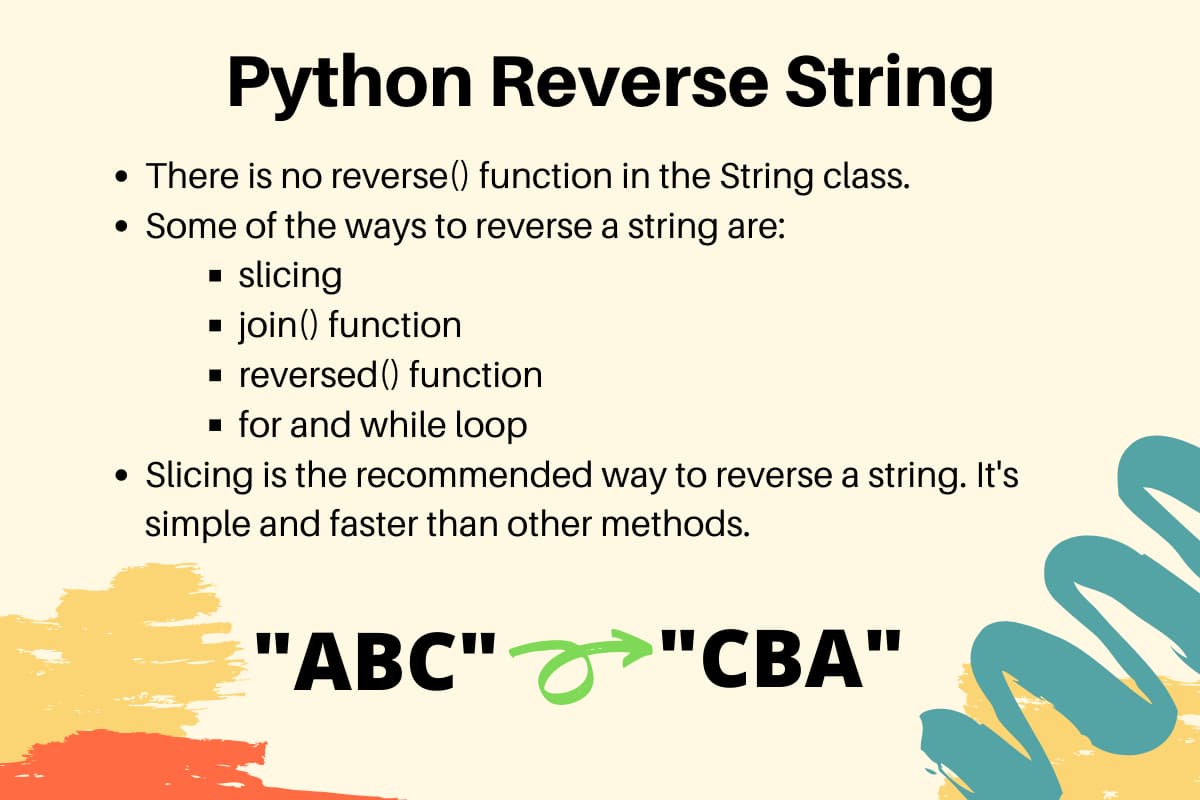
Python String doesn’t have a built-in reverse() function. However, there are various ways to reverse a string in Python.
1. How to Reverse a String in Python?
Some of the common ways to reverse a string are:
- Using Slicing to create a reverse copy of the string.
- Using for loop and appending characters in reverse order
- Using while loop to iterate string characters in reverse order and append them
- Using string join() function with reversed() iterator
- Creating a list from the string and then calling its
reverse()function - Using Recursion
1.1) Python Reverse String using Slicing
def reverse_slicing(s):
    return s[::-1]

input_str = 'ABç∂EF'

if __name__ == "__main__":
    print('Reverse String using slicing =', reverse_slicing(input_str))
If you run above Python script, the output will be:
Reverse String using slicing = FE∂çBA
1.2) Reverse String using For Loop
def reverse_for_loop(s):
    s1 = ''
    for c in s:
        s1 = c + s1  # appending chars in reverse order
    return s1

input_str = 'ABç∂EF'

if __name__ == "__main__":
    print('Reverse String using for loop =', reverse_for_loop(input_str))
Output: Reverse String using for loop = FE∂çBA
1.3) Reverse a String using While Loop
def reverse_while_loop(s):
    s1 = ''
    length = len(s) - 1
    while length >= 0:
        s1 = s1 + s[length]
        length = length - 1
    return s1

input_str = 'ABç∂EF'

if __name__ == "__main__":
    print('Reverse String using while loop =', reverse_while_loop(input_str))
1.4) Reverse a String using join() and reversed()
def reverse_join_reversed_iter(s):
    s1 = ''.join(reversed(s))
    return s1
1.5) Python Reverse String using List reverse()
def reverse_list(s):
    temp_list = list(s)
    temp_list.reverse()
    return ''.join(temp_list)
1.6) Python Reverse String using Recursion
def reverse_recursion(s):
    if len(s) == 0:
        return s
    else:
        return reverse_recursion(s[1:]) + s[0]
2. Best Way to Reverse a String in Python
We can reverse a string through multiple algorithms. We have already seen six of them. But which of them you should choose to reverse a string. We can use timeit module to run multiple iterations of these functions and get the average time required to run them. All the above functions are stored in a python script named string_reverse.py. I executed all these functions one by one for 1,00,000 times using the timeit module and got the average of the best 5 runs.
$ python3.7 -m timeit --number 100000 --unit usec 'import string_reverse' 'string_reverse.reverse_slicing("ABç∂EF"*10)'
100000 loops, best of 5: 0.449 usec per loop

$ python3.7 -m timeit --number 100000 --unit usec 'import string_reverse' 'string_reverse.reverse_list("ABç∂EF"*10)'
100000 loops, best of 5: 2.46 usec per loop

$ python3.7 -m timeit --number 100000 --unit usec 'import string_reverse' 'string_reverse.reverse_join_reversed_iter("ABç∂EF"*10)'
100000 loops, best of 5: 2.49 usec per loop

$ python3.7 -m timeit --number 100000 --unit usec 'import string_reverse' 'string_reverse.reverse_for_loop("ABç∂EF"*10)'
100000 loops, best of 5: 5.5 usec per loop

$ python3.7 -m timeit --number 100000 --unit usec 'import string_reverse' 'string_reverse.reverse_while_loop("ABç∂EF"*10)'
100000 loops, best of 5: 9.4 usec per loop

$ python3.7 -m timeit --number 100000 --unit usec 'import string_reverse' 'string_reverse.reverse_recursion("ABç∂EF"*10)'
100000 loops, best of 5: 24.3 usec per loop
 The below table presents the results and slowness of an algorithm from the best one.
| Algorithm | TimeIt Execution Time (Best of 5) | Slowness |
|---|---|---|
| Slicing | 0.449 usec | 1x |
| List reverse() | 2.46 usec | 5.48x |
| reversed() + join() | 2.49 usec | 5.55x |
| for loop | 5.5 usec | 12.25x |
| while loop | 9.4 usec | 20.94x |
| Recursion | 24.3 usec | 54.12x |
3. Summary
We should use slicing to reverse a string in Python. Its code is very simple and small and we don’t need to write our own logic to reverse the string. Also, it’s the fastest way to reverse a string as identified by the above test executions.
You can checkout complete python script and more Python examples from our GitHub Repository.
Thanks for learning with the DigitalOcean Community. Check out our offerings for compute, storage, networking, and managed databases.
About the author

Java and Python Developer for 20+ years, Open Source Enthusiast, Founder of https://www.askpython.com/, https://www.linuxfordevices.com/, and JournalDev.com (acquired by DigitalOcean). Passionate about writing technical articles and sharing knowledge with others. Love Java, Python, Unix and related technologies. Follow my X @PankajWebDev
Still looking for an answer?
 This work is licensed under a Creative Commons Attribution-NonCommercial- ShareAlike 4.0 International License.
Become a contributor for community
Get paid to write technical tutorials and select a tech-focused charity to receive a matching donation.

DigitalOcean Documentation
Full documentation for every DigitalOcean product.

Resources for startups and AI-native businesses
The Wave has everything you need to know about building a business, from raising funding to marketing your product.
The developer cloud
Scale up as you grow — whether you're running one virtual machine or ten thousand.

Start building today
From GPU-powered inference and Kubernetes to managed databases and storage, get everything you need to build, scale, and deploy intelligent applications.