Python numpy append() function is used to merge two arrays. This function returns a new array and the original array remains unchanged.
NumPy append() Syntax
The function syntax is:
numpy.append(arr, values, axis=None)
- The arr can be an array-like object or a NumPy array. The values are appended to a copy of this array.
- The values are array-like objects and it’s appended to the end of the “arr” elements.
- The axis specifies the axis along which values are appended. If the axis is not provided, both the arrays are flattened.
Python numpy.append() Examples
Let’s look at some examples of NumPy append() function.
1. Flattening Two Arrays
import numpy as np

arr1 = np.array([[1, 2], [3, 4]])
arr2 = np.array([[10, 20], [30, 40]])

# no axis provided, array elements will be flattened
arr_flat = np.append(arr1, arr2)

print(arr_flat)  # [ 1  2  3  4 10 20 30 40]
2. Merging Along Axis
import numpy as np

arr_merged = np.append([[1, 2], [3, 4]], [[10, 20], [30, 40]], axis=0)
print(f'Merged 2x2 Arrays along Axis-0:\n{arr_merged}')

arr_merged = np.append([[1, 2], [3, 4]], [[10, 20], [30, 40]], axis=1)
print(f'Merged 2x2 Arrays along Axis-1:\n{arr_merged}')
Output:
Merged 2x2 Arrays along Axis-0:
[[ 1  2]
 [ 3  4]
 [10 20]
 [30 40]]
Merged 2x2 Arrays along Axis-1:
[[ 1  2 10 20]
 [ 3  4 30 40]]
- When the 2x2 arrays are merged along the x-axis, the output array size is 4x2.
- When the 2x2 arrays are merged along the y-axis, the output array size is 2x4.
3. Merging Arrays of different shapes
The append() function throws ValueError if both the arrays are of different shape, excluding the axis. Let’s understand this scenario with a simple example.
arr3 = np.append([[1, 2]], [[1, 2, 3], [1, 2, 3]])
print(arr3)

arr3 = np.append([[1, 2]], [[1, 2], [3, 4]], axis=0)
print(arr3)
- In the first example, the array elements are flattened. So even if they have completely different size - 1x2 and 2x3, the append() works fine.
- In the second example, the array shapes are 1x2 and 2x2. Since we are appending along the 0-axis, the 0-axis shape can be different. The other shapes should be the same, so this append() will also work fine.
Output:
[1 2 1 2 3 1 2 3]

[[1 2]
 [1 2]
 [3 4]]
Let’s look at another example where ValueError will be raised.
>>> import numpy as np
>>>
>>> arr3 = np.append([[1, 2]], [[1, 2, 3]], axis=0)
Traceback (most recent call last):
  File "", line 1, in
  File "/Library/Frameworks/Python.framework/Versions/3.7/lib/python3.7/site-packages/numpy/lib/function_base.py", line 4528, in append
    return concatenate((arr, values), axis=axis)
ValueError: all the input array dimensions except for the concatenation axis must match exactly
>>>
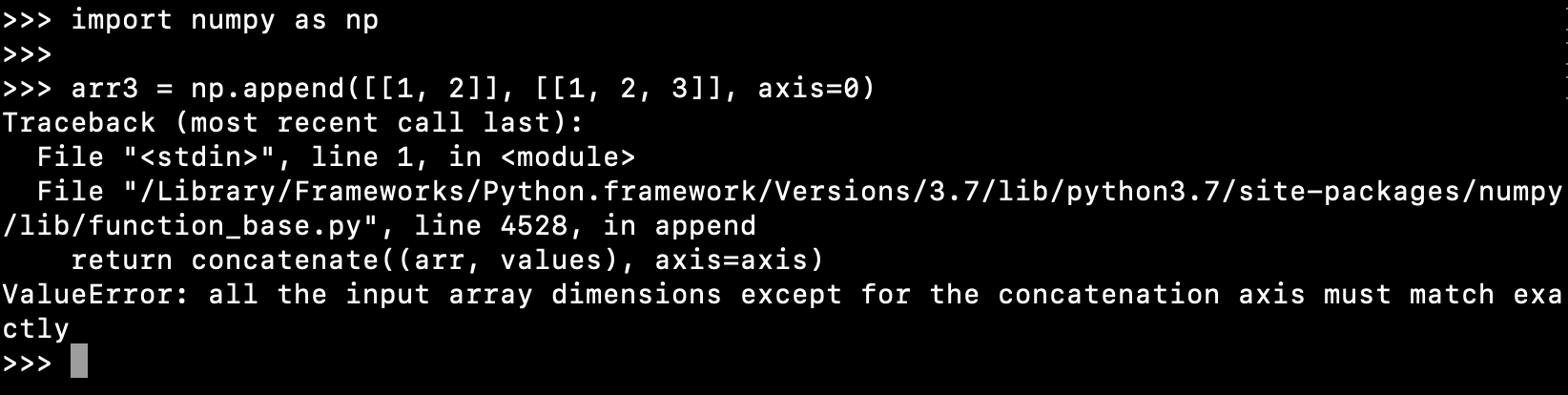
The array shapes are 1x2 and 2x3. Since the axis-1 shapes are different, ValueError is raised. Reference: API Doc
Thanks for learning with the DigitalOcean Community. Check out our offerings for compute, storage, networking, and managed databases.
About the author

Java and Python Developer for 20+ years, Open Source Enthusiast, Founder of https://www.askpython.com/, https://www.linuxfordevices.com/, and JournalDev.com (acquired by DigitalOcean). Passionate about writing technical articles and sharing knowledge with others. Love Java, Python, Unix and related technologies. Follow my X @PankajWebDev
Still looking for an answer?
 This work is licensed under a Creative Commons Attribution-NonCommercial- ShareAlike 4.0 International License.
Become a contributor for community
Get paid to write technical tutorials and select a tech-focused charity to receive a matching donation.

DigitalOcean Documentation
Full documentation for every DigitalOcean product.
Resources for startups and AI-native businesses
The Wave has everything you need to know about building a business, from raising funding to marketing your product.
The developer cloud
Scale up as you grow — whether you're running one virtual machine or ten thousand.
Start building today
From GPU-powered inference and Kubernetes to managed databases and storage, get everything you need to build, scale, and deploy intelligent applications.