Not using Ubuntu 14.04?
Choose a different version or distribution.
Introduction
When setting up a web server, there are often sections of the site that you wish to restrict access to. Web applications often provide their own authentication and authorization methods, but the web server itself can be used to restrict access if these are inadequate or unavailable.
In this guide, we’ll demonstrate how to password protect assets on an Nginx web server running on Ubuntu 14.04.
Prerequisites
To get started, you will need access to an Ubuntu 14.04 server environment. You will need a non-root user with sudo privileges in order to perform administrative tasks. To learn how to create such a user, follow our Ubuntu 14.04 initial server setup guide.
If you haven’t done so already, install Nginx on your machine by typing:
- sudo apt-get update
- sudo apt-get install nginx
Create the Password File
To start out, we need to create the file that will hold our username and password combinations. You can do this by using the OpenSSL utilities that may already be available on your server. Alternatively, you can use the purpose-made htpasswd utility included in the apache2-utils package (Nginx password files use the same format as Apache). Choose the method below that you like best.
Create the Password File Using the OpenSSL Utilities
If you have OpenSSL installed on your server, you can create a password file with no additional packages. We will create a hidden file called .htpasswd in the /etc/nginx configuration directory to store our username and password combinations.
You can add a username to the file using this command. We are using sammy as our username, but you can use whatever name you’d like:
- sudo sh -c "echo -n 'sammy:' >> /etc/nginx/.htpasswd"
Next, add an encrypted password entry for the username by typing:
- sudo sh -c "openssl passwd -apr1 >> /etc/nginx/.htpasswd"
You can repeat this process for additional usernames. You can see how the usernames and encrypted passwords are stored within the file by typing:
- cat /etc/nginx/.htpasswd
Outputsammy:$apr1$wI1/T0nB$jEKuTJHkTOOWkopnXqC1d1
Create the Password File Using Apache Utilities
While OpenSSL can encrypt passwords for Nginx authentication, many users find it easier to use a purpose-built utility. The htpasswd utility, found in the apache2-utils package, serves this function well.
Install the apache2-utils package on your server by typing:
- sudo apt-get update
- sudo apt-get install apache2-utils
Now, you have access to the htpasswd command. We can use this to create a password file that Nginx can use to authenticate users. We will create a hidden file for this purpose called .htpasswd within our /etc/nginx configuration directory.
The first time we use this utility, we need to add the -c option to create the specified file. We specify a username (sammy in this example) at the end of the command to create a new entry within the file:
- sudo htpasswd -c /etc/nginx/.htpasswd sammy
You will be asked to supply and confirm a password for the user.
Leave out the -c argument for any additional users you wish to add:
- sudo htpasswd /etc/nginx/.htpasswd another_user
If we view the contents of the file, we can see the username and the encrypted password for each record:
- cat /etc/nginx/.htpasswd
Outputsammy:$apr1$lzxsIfXG$tmCvCfb49vpPFwKGVsuYz.
another_user:$apr1$p1E9MeAf$kiAhneUwr.MhAE2kKGYHK.
Configure Nginx Password Authentication
Now that we have a file with our users and passwords in a format that Nginx can read, we need to configure Nginx to check this file before serving our protected content.
Begin by opening up the server block configuration file that you wish to add a restriction to. For our example, we’ll be using the default server block file installed through Ubuntu’s Nginx package:
- sudo nano /etc/nginx/sites-enabled/default
Inside, with the comments stripped, the file should look similar to this:
server {
    listen 80 default_server;
    listen [::]:80 default_server ipv6only=on;

    root /usr/share/nginx/html;
    index index.html index.htm;

    server_name localhost;

    location / {
        try_files $uri $uri/ =404;
    }
}
To set up authentication, you need to decide on the context to restrict. Among other choices, Nginx allows you to set restrictions on the server level or inside a specific location. In our example, we’ll restrict the entire document root with a location block, but you can modify this listing to only target a specific directory within the web space:
Within this location block, use the auth_basic directive to turn on authentication and to choose a realm name to be displayed to the user when prompting for credentials. We will use the auth_basic_user_file directive to point Nginx to the password file we created:
server {
    listen 80 default_server;
    listen [::]:80 default_server ipv6only=on;

    root /usr/share/nginx/html;
    index index.html index.htm;

    server_name localhost;

    location / {
        try_files $uri $uri/ =404;
        auth_basic "Restricted Content";
        auth_basic_user_file /etc/nginx/.htpasswd;
    }
}
Save and close the file when you are finished. Restart Nginx to implement your password policy:
- sudo service nginx restart
The directory you specified should now be password protected.
Confirm the Password Authentication
To confirm that your content is protected, try to access your restricted content in a web browser. You should be presented with a username and password prompt that looks like this:
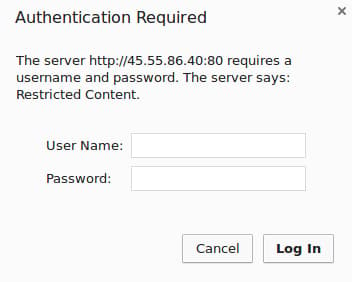
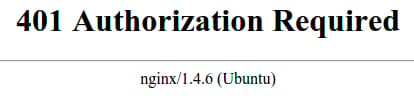
If you enter the correct credentials, you will be allowed to access the content. If you enter the wrong credentials or hit “Cancel”, you will see the “Authorization Required” error page:
Conclusion
You should now have everything you need to set up basic authentication for your site. Keep in mind that password protection should be combined with SSL encryption so that your credentials are not sent to the server in plain text. To learn how to create a self-signed SSL certificate to use with Nginx, follow this guide. To learn how to install a commercial certificate, follow this guide.
Thanks for learning with the DigitalOcean Community. Check out our offerings for compute, storage, networking, and managed databases.
About the author

Former Senior Technical Writer at DigitalOcean, specializing in DevOps topics across multiple Linux distributions, including Ubuntu 18.04, 20.04, 22.04, as well as Debian 10 and 11.
Still looking for an answer?
 This work is licensed under a Creative Commons Attribution-NonCommercial- ShareAlike 4.0 International License.
Become a contributor for community
Get paid to write technical tutorials and select a tech-focused charity to receive a matching donation.

DigitalOcean Documentation
Full documentation for every DigitalOcean product.

Resources for startups and AI-native businesses
The Wave has everything you need to know about building a business, from raising funding to marketing your product.
The developer cloud
Scale up as you grow — whether you're running one virtual machine or ten thousand.

Start building today
From GPU-powered inference and Kubernetes to managed databases and storage, get everything you need to build, scale, and deploy intelligent applications.