By Erika Heidi, Vadym Kalsin and Timothy Nolan
Not using CentOS 7?
Choose a different version or distribution.
Introduction
Let’s Encrypt is a Certificate Authority (CA) that provides free certificates for Transport Layer Security (TLS) encryption, thereby enabling encrypted HTTPS on web servers. It simplifies the process of creation, validation, signing, installation, and renewal of certificates by providing a software client that automates most of the steps—Certbot.
In this tutorial, you will use Certbot to set up a TLS/SSL certificate from Let’s Encrypt on a CentOS 7 server running Apache as a web server. Additionally, you will automate the certificate renewal process using a cron job, which you can learn more about by reading How To Use Cron To Automate Tasks On a VPS.
Prerequisites
In order to complete this guide, you will need:
- One CentOS 7 server set up by following the CentOS 7 initial server setup guide with a non-root user who has
sudoprivileges. - A basic firewall configured by following the Additional Recommended Steps for New CentOS 7 Servers guide.
- Apache installed on the CentOS 7 server with a virtual host configured. You can learn how to set this up by following our tutorial How To Install the Apache Web Server on CentOS 7. Be sure that you have a virtual host file for your domain. This tutorial will use
/etc/httpd/sites-available/example.com.confas an example. - You should own or control the registered domain name that you wish to use the certificate with. If you do not already have a registered domain name, you may purchase one on Namecheap, get one for free on Freenom, or use the domain registrar of your choice.
- A DNS A Record that points your domain to the public IP address of your server. You can follow this introduction to DigitalOcean DNS for details on how to add them with the DigitalOcean platform. DNS A records are required because of how Let’s Encrypt validates that you own the domain it is issuing a certificate for. For example, if you want to obtain a certificate for
example.com, that domain must resolve to your server for the validation process to work. Our setup will useexample.comandwww.example.comas the domain names, both of which will require a valid DNS record.
When you have all of these prerequisites completed, move on to install the Let’s Encrypt client software.
Step 1 — Installing the Certbot Let’s Encrypt Client
To use Let’s Encrypt to obtain an SSL certificate, you first need to install Certbot and mod_ssl, an Apache module that provides support for SSL v3 encryption.
The certbot package is not available through the package manager by default. You will need to enable the EPEL repository to install Certbot.
To add the CentOS 7 EPEL repository, run the following command:
- sudo yum install epel-release
Now that you have access to the repository, install all of the required packages:
- sudo yum install certbot python2-certbot-apache mod_ssl
During the installation process you will be asked about importing a GPG key. This key will verify the authenticity of the package you are installing. To allow the installation to finish, accept the GPG key by typing y and pressing ENTER when prompted to do so.
With these services installed, you’re now ready to run Certbot and fetch your certificates.
Step 2 — Obtaining a Certificate
Now that Certbot is installed, you can use it to request an SSL certificate for your domain.
Using the certbot Let’s Encrypt client to generate the SSL Certificate for Apache automates many of the steps in the process. The client will automatically obtain and install a new SSL certificate that is valid for the domains you provide as parameters.
To execute the interactive installation and obtain a certificate that covers only a single domain, run the certbot command with:
- sudo certbot --apache -d example.com
This runs certbot with the --apache plugin and specifies the domain to configure the certificate for with the -d flag.
If you want to install a single certificate that is valid for multiple domains or subdomains, you can pass them as additional parameters to the command, tagging each new domain or subdomain with the -d flag. The first domain name in the list of parameters will be the base domain used by Let’s Encrypt to create the certificate. For this reason, pass the base domain name as first in the list, followed by any additional subdomains or aliases:
- sudo certbot --apache -d example.com -d www.example.com
The base domain in this example is example.com.
The certbot utility can also prompt you for domain information during the certificate request procedure. To use this functionality, call certbot without any domains:
- sudo certbot --apache
The program will present you with a step-by-step guide to customize your certificate options. It will ask you to provide an email address for lost key recovery and notices, and then prompt you to agree to the terms of service. If you did not specify your domains on the command line, you will be prompted for that as well. If your Virtual Host files do not specify the domain they serve explicitly using the ServerName directive, you will be asked to choose the virtual host file. In most cases, the default ssl.conf file will work.
You will also be able to choose between enabling both http and https access or forcing all requests to redirect to https. For better security, it is recommended to choose the option 2: Redirect if you do not have any special need to allow unencrypted connections. Select your choice then hit ENTER.
OutputPlease choose whether or not to redirect HTTP traffic to HTTPS, removing HTTP access.
- - - - - - - - - - - - - - - - - - - - - - - - - - - - - - - - - - - - - - - -
1: No redirect - Make no further changes to the webserver configuration.
2: Redirect - Make all requests redirect to secure HTTPS access. Choose this for
new sites, or if you're confident your site works on HTTPS. You can undo this
change by editing your web server's configuration.
- - - - - - - - - - - - - - - - - - - - - - - - - - - - - - - - - - - - - - - -
Select the appropriate number [1-2] then [enter] (press 'c' to cancel):2
When the installation is successfully finished, you will see a message similar to this:
OutputIMPORTANT NOTES:
 - Congratulations! Your certificate and chain have been saved at:
   /etc/letsencrypt/live/example.com/fullchain.pem
   Your key file has been saved at:
   /etc/letsencrypt/live/example.com/privkey.pem
   Your cert will expire on 2019-08-14. To obtain a new or tweaked
   version of this certificate in the future, simply run certbot again
   with the "certonly" option. To non-interactively renew *all* of
   your certificates, run "certbot renew"
 - If you like Certbot, please consider supporting our work by:

   Donating to ISRG / Let's Encrypt:   https://letsencrypt.org/donate
   Donating to EFF:                    https://eff.org/donate-le
The generated certificate files will be available within a subdirectory named after your base domain in the /etc/letsencrypt/live directory.
Now that your certificates are downloaded, installed, and loaded, you can check your SSL certificate status to make sure that everything is working.
Step 3 — Checking your Certificate Status
At this point, you can ensure that Certbot created your SSL certificate correctly by using the SSL Server Test from the cloud security company Qualys.
Open the following link in your preferred web browser, replacing example.com with your base domain:
https://www.ssllabs.com/ssltest/analyze.html?d=example.com
You will land on a page that immediately begins testing the SSL connection to your server:
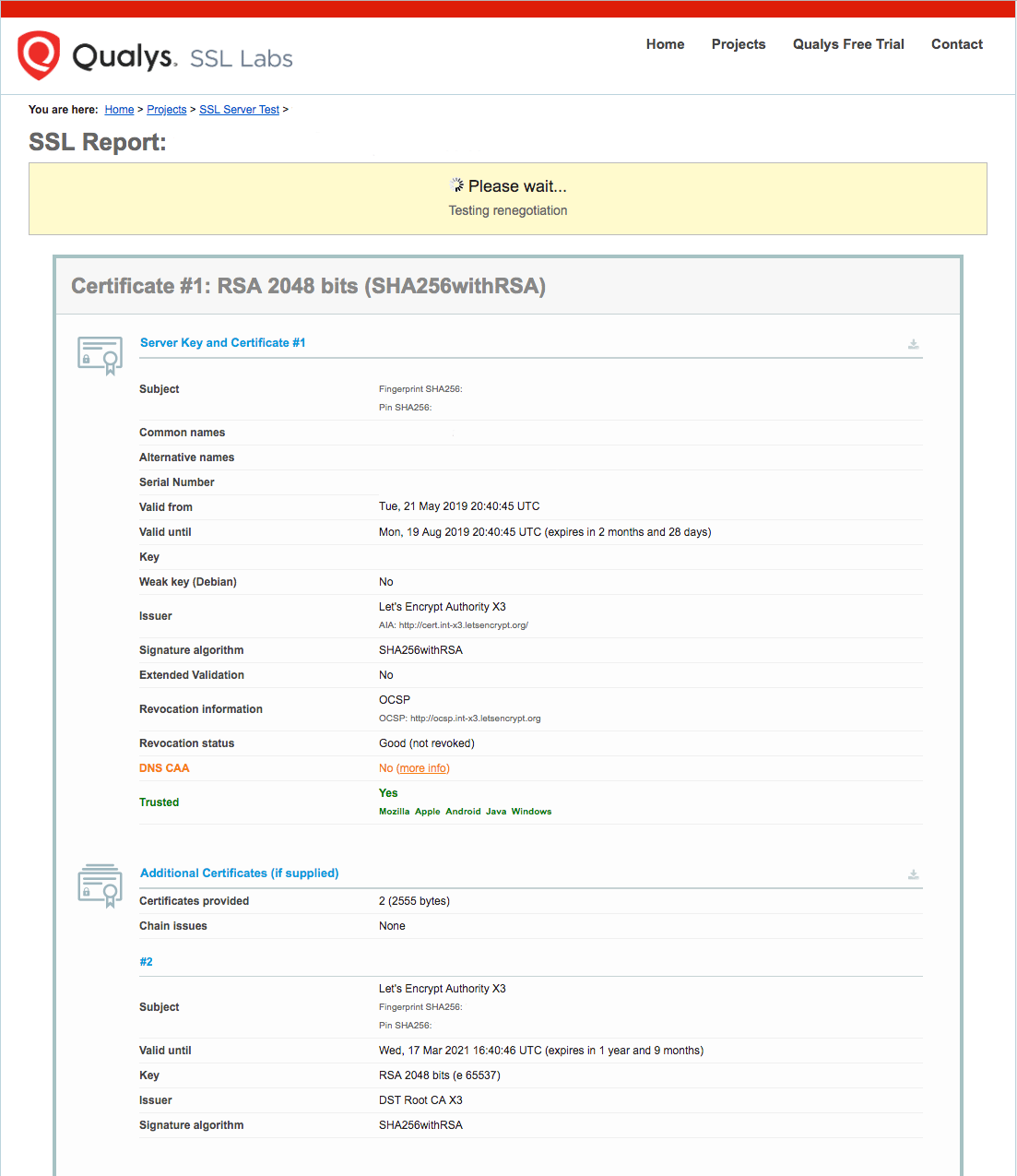
Once the test starts running, it may take a few minutes to complete. The status of the test will update in your browser.
When the testing finishes, the page will display a letter grade that rates the security and quality of your server’s configuration. At the time of this writing, default settings will give an A rating:
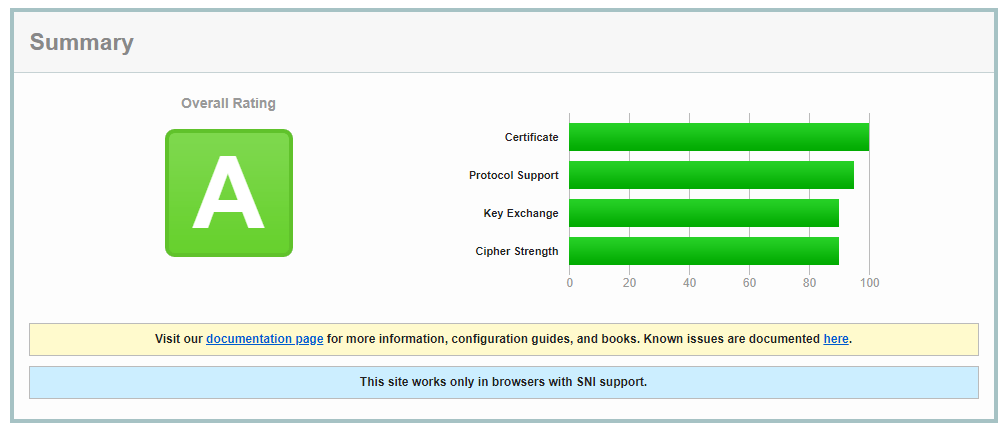
For more information about how SSL Labs determines these grades, check out the SSL Labs Grading post detailing the updates made to the grading scheme in January, 2018.
Try reloading your website using https:// and notice your browser’s security indicator. It will now indicate that the site is properly secured, usually with a green lock icon.
With your SSL certificate up and verified, the next step is to set up auto-renewal for your certificate to keep your certificate valid.
Step 4 — Setting Up Auto Renewal
Let’s Encrypt certificates are valid for 90 days, but it’s recommended that you renew the certificates every 60 days to allow a margin of error. Because of this, it is a best practice to automate this process to periodically check and renew the certificate.
First, let’s examine the command that you will use to renew the certificate. The certbot Let’s Encrypt client has a renew command that automatically checks the currently installed certificates and tries to renew them if they are less than 30 days away from the expiration date. By using the --dry-run option, you can run a simulation of this task to test how renew works:
- sudo certbot renew --dry-run
The output should look similar to this:
OutputSaving debug log to /var/log/letsencrypt/letsencrypt.log

- - - - - - - - - - - - - - - - - - - - - - - - - - - - - - - - - - - - - - - -
Processing /etc/letsencrypt/renewal/example.com.conf
- - - - - - - - - - - - - - - - - - - - - - - - - - - - - - - - - - - - - - - -
Cert not due for renewal, but simulating renewal for dry run
Plugins selected: Authenticator apache, Installer apache
Starting new HTTPS connection (1): acme-staging-v02.api.letsencrypt.org
Renewing an existing certificate
Performing the following challenges:
http-01 challenge for example.com
http-01 challenge for www.example.com
Waiting for verification...
Cleaning up challenges
Resetting dropped connection: acme-staging-v02.api.letsencrypt.org

- - - - - - - - - - - - - - - - - - - - - - - - - - - - - - - - - - - - - - - -
new certificate deployed with reload of apache server; fullchain is
/etc/letsencrypt/live/example.com/fullchain.pem
- - - - - - - - - - - - - - - - - - - - - - - - - - - - - - - - - - - - - - - -

- - - - - - - - - - - - - - - - - - - - - - - - - - - - - - - - - - - - - - - -
** DRY RUN: simulating 'certbot renew' close to cert expiry
**          (The test certificates below have not been saved.)

Congratulations, all renewals succeeded. The following certs have been renewed:
  /etc/letsencrypt/live/example.com/fullchain.pem (success)
...
Notice that if you created a bundled certificate with multiple domains, only the base domain name will be shown in the output, but the renewal will be valid for all domains included in this certificate.
A practical way to ensure your certificates will not get outdated is to create a cron job that will periodically execute the automatic renewal command for you. Since the renewal first checks for the expiration date and only executes the renewal if the certificate is less than 30 days away from expiration, it is safe to create a cron job that runs every week or even every day.
The official Certbot documentation recommends running cron twice per day. This will ensure that, in case Let’s Encrypt initiates a certificate revocation, there will be no more than half a day before Certbot renews your certificate.
Edit the crontab to create a new job that will run the renewal twice per day. To edit the crontab for the root user, run:
- sudo crontab -e
Your text editor will open the default crontab which is an empty text file at this point. This tutorial will use the vi text editor. To learn more about this text editor and its successor vim, check out our Installing and Using the Vim Text Editor on a Cloud Server tutorial.
Enter insert mode by pressing i and add in the following line:
crontab0 0,12 * * * python -c 'import random; import time; time.sleep(random.random() * 3600)' && certbot renew
When you’re finished, press ESC to leave insert mode, then :wq and ENTER to save and exit the file. This will create a new cron job that will execute at noon and midnight every day. Adding an element of randomness to your cron jobs will ensure that hourly jobs do not all happen at the same minute, causing a server spike; python -c 'import random; import time; time.sleep(random.random() * 3600)' will select a random minute within the hour for your renewal tasks.
For more information on how to create and schedule cron jobs, you can check our How to Use Cron to Automate Tasks in a VPS guide. More detailed information about renewal can be found in the Certbot documentation.
Conclusion
In this guide you installed the Let’s Encrypt Certbot client, downloaded SSL certificates for your domain, and set up automatic certificate renewal. If you have any questions about using Certbot, you can check the official Certbot documentation. We also recommend that you check the official Let’s Encrypt blog for important updates from time to time.
Thanks for learning with the DigitalOcean Community. Check out our offerings for compute, storage, networking, and managed databases.
About the author(s)
Dev/Ops passionate about open source, PHP, and Linux. Former Senior Technical Writer at DigitalOcean. Areas of expertise include LAMP Stack, Ubuntu, Debian 11, Linux, Ansible, and more.
Monitoring engineer
Former Senior Technical Editor at DigitalOcean, fiction writer and podcaster elsewhere, always searching for the next good nautical pun! Areas of expertise include Node.js, PostgreSQL, CSS, JavaScript.
Still looking for an answer?
 This work is licensed under a Creative Commons Attribution-NonCommercial- ShareAlike 4.0 International License.
Become a contributor for community
Get paid to write technical tutorials and select a tech-focused charity to receive a matching donation.

DigitalOcean Documentation
Full documentation for every DigitalOcean product.

Resources for startups and AI-native businesses
The Wave has everything you need to know about building a business, from raising funding to marketing your product.
The developer cloud
Scale up as you grow — whether you're running one virtual machine or ten thousand.

Start building today
From GPU-powered inference and Kubernetes to managed databases and storage, get everything you need to build, scale, and deploy intelligent applications.