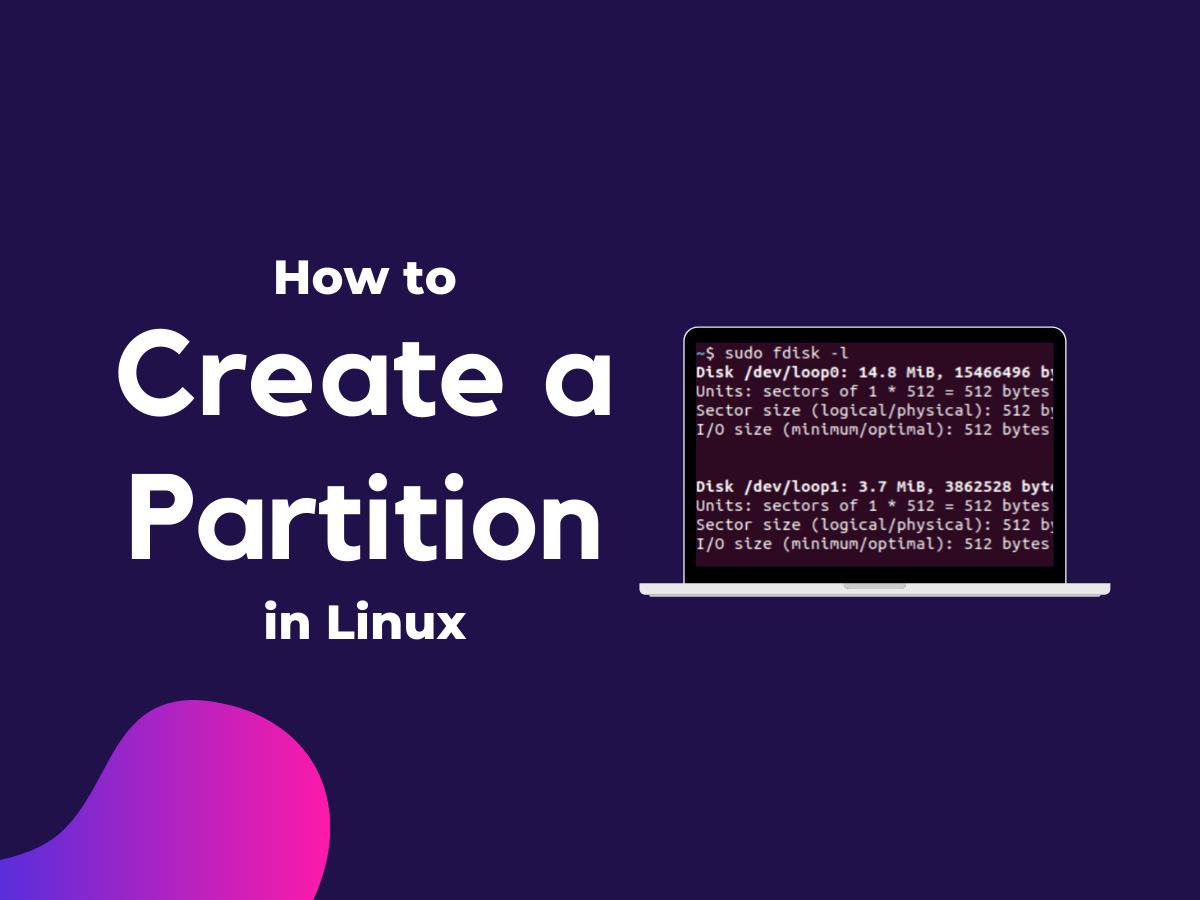
Creating a partition in Linux lets you divide a single physical disk into separate, independent sections that the system treats like distinct drives. Partitioning is how you allocate dedicated space for specific uses, isolate the operating system from user data, set up swap, run more than one operating system on one machine, and limit the damage when a filesystem becomes corrupted. Because each partition behaves like a separate disk, a problem on one leaves the data on the others untouched.
In this tutorial, you will learn how to create a partition in Linux from the command line using the two most common tools, fdisk and parted. You will choose between an MBR and a GPT partition table, identify the correct disk safely, create and set the type of a new partition, format it with a filesystem such as ext4 or xfs, mount it temporarily, make the mount persistent through /etc/fstab, delete a partition, and fix the errors that come up most often.
Warning: Partitioning and formatting are destructive operations. Writing a new partition table or running mkfs on the wrong device will permanently erase data. Always confirm the target disk with lsblk and sudo fdisk -l before you write any changes, and back up important data first.
Key takeaways
- Partitioning divides one physical disk into independent sections, each of which can hold its own filesystem and be mounted separately.
- A disk needs a partition table before it can hold partitions, and the two common types are MBR (msdos) and GPT.
- MBR supports disks up to about 2.2 TB (2,199,023,255,040 bytes with 512-byte sectors) and a maximum of four primary partitions, so it suits older BIOS systems and small disks.
- GPT removes the 2 TB ceiling, supports up to 128 partitions by default, and is the right default for large disks and UEFI systems.
fdiskis an interactive tool available by default on most distributions and handles both MBR and GPT. GPT support was introduced as experimental in util-linux 2.23 and became stable in later releases; modern distributions ship a fully capable version.partedsupports large disks natively and can run non-interactively, which makes it the better choice for scripting and automation.- Creating a partition is only the first step: you must format it with a filesystem (for example
mkfs.ext4ormkfs.xfs) and mount it before you can store data on it. - Adding a UUID-based entry to
/etc/fstabmakes a partition mount automatically every time the system boots.
Prerequisites
Before you create a partition, make sure you have the following in place.
You need a Linux system with a second disk or unallocated space to work on, and access to a user account with sudo privileges so you can run administrative commands. If you need to set this up first, follow the guide on how to create a new sudo-enabled user. You should also be comfortable working in a Linux terminal, since every step in this tutorial uses the command line.
Both fdisk and parted are part of standard utilities on most distributions. fdisk ships with the util-linux package and is almost always present, while parted may need to be installed on a minimal system with sudo apt install parted on Ubuntu and Debian or sudo dnf install parted on Fedora, Rocky Linux, and other Red Hat based distributions.
Understanding partition tables: GPT vs MBR
A disk cannot hold partitions until it has a partition table, the small structure at the start of the disk that records where each partition begins and ends. The two formats you will encounter are MBR (also shown as msdos) and GPT, and choosing the right one matters before you create anything.
MBR (Master Boot Record) is the older standard. It can address disks only up to roughly 2.2 TB (2,199,023,255,040 bytes with 512-byte sectors) and allows a maximum of four primary partitions. To exceed four, MBR lets you turn one primary partition into an extended partition that holds additional logical partitions.
GPT (GUID Partition Table) is the modern replacement defined by the UEFI standard. It removes the 2 TB limit (addressing disks up to around 9.4 zettabytes), supports up to 128 partitions by default without extended or logical partitions, and keeps a backup copy of the table at the end of the disk for resilience.
As a quick rule, choose MBR for legacy BIOS systems or disks under 2 TB that need compatibility with older systems, and choose GPT for any disk larger than 2 TB, for UEFI systems, or simply as a modern default.
You can check which partition table a disk already uses before making changes. The following command prints disk details, including the partition table type:
- sudo fdisk -l /dev/vda
Look for the Disklabel type line in the output, which reports either dos (MBR) or gpt:
Disk /dev/vda: 160 GiB, 171798691840 bytes, 335544320 sectors
Units: sectors of 1 * 512 = 512 bytes
Sector size (logical/physical): 512 bytes / 512 bytes
I/O size (minimum/optimal): 512 bytes / 512 bytes
Disklabel type: gpt
Disk identifier: DCDD7CFE-DCA3-4181-877E-B1DFCF70E9AA
Choosing the right partitioning tool
Linux gives you several tools for the same job, and the best one depends on your disk size, whether you want to script the process, and whether you have a desktop environment. The three most common options are fdisk, an interactive command-line tool installed by default on nearly every distribution that handles both MBR and GPT (GPT support was introduced as experimental in util-linux 2.23 and is stable in all modern releases); parted, a command-line tool that supports large disks natively and can run non-interactively with the --script flag, which makes it well suited for automation; and GParted, a graphical front end that is convenient on desktops with a GUI but is not typically available on headless servers.
The following table compares the three tools so you can pick the right one for your situation:
| Feature | fdisk |
parted |
GParted |
|---|---|---|---|
| Interface | Interactive CLI | CLI (interactive or scripted) | Graphical (GUI) |
| Partition tables | MBR and GPT | MBR and GPT | MBR and GPT |
| Disks larger than 2 TB | Yes (with GPT) | Yes | Yes |
| Scripting and automation | Limited | Yes (--script) |
No |
| Default availability | Installed on most distros | Often preinstalled, may need install | Desktop only |
| Best for | Quick interactive edits on a server | Automation, scripting, and large disks | Visual editing on a desktop |
How to identify your target disk using lsblk and fdisk -l
lsblk and fdisk -lBefore you partition anything, you must identify the correct disk, because choosing the wrong device can destroy data. Two commands give you a clear picture of the disks and partitions on your system.
The lsblk command lists all block devices in an easy-to-read tree, showing each disk and its existing partitions along with their sizes and mount points:
- lsblk
The output shows your disks and any partitions beneath them:
NAME    MAJ:MIN RM  SIZE RO TYPE MOUNTPOINTS
sda       8:0    0  160G  0 disk
├─sda1    8:1    0  159G  0 part /
├─sda14   8:14   0    4M  0 part
├─sda15   8:15   0  106M  0 part /boot/efi
└─sda16   8:16   0  913M  0 part /boot
sdb       8:16   0   20G  0 disk
In this example, sdb is a 20 GiB disk with no partitions, which makes it the disk to work on. For a more detailed view that includes partition tables, types, and sizes, use fdisk -l:
- sudo fdisk -l
Disk /dev/sda: 160 GiB, 171798691840 bytes, 335544320 sectors
Units: sectors of 1 * 512 = 512 bytes
Sector size (logical/physical): 512 bytes / 512 bytes
I/O size (minimum/optimal): 512 bytes / 512 bytes
Disklabel type: gpt
Disk identifier: DCDD7CFE-DCA3-4181-877E-B1DFCF70E9AA

Device       Start       End   Sectors  Size Type
/dev/sda1  2099200 335544286 333445087  159G Linux filesystem
/dev/sda14    2048     10239      8192    4M BIOS boot
/dev/sda15   10240    227327    217088  106M EFI System
/dev/sda16  227328   2097152   1869825  913M Linux extended boot

Partition table entries are not in disk order.


Disk /dev/sdb: 20 GiB, 21474836480 bytes, 41943040 sectors
Units: sectors of 1 * 512 = 512 bytes
Sector size (logical/physical): 512 bytes / 512 bytes
I/O size (minimum/optimal): 512 bytes / 512 bytes
You will be prompted for your password to confirm your sudo privileges. The command lists every disk and its current partition layout, which lets you confirm the device path (for example /dev/sdb) before you continue.
How to create a partition using fdisk
fdiskfdisk is a text-based utility for viewing and managing disk partitions, and its interactive command mode is the classic way to create a partition in Linux. The steps below walk through a complete session, from opening the disk to writing the changes. Start by opening the target disk in command mode, replacing /dev/sdb with the disk you identified earlier:
- sudo fdisk /dev/sdb
Once you are in command mode, fdisk waits for single-character commands. The interface can be confusing at first, so press m at any time to see the full list of available commands:
OutputWelcome to fdisk (util-linux 2.40.2).
Changes will remain in memory only, until you decide to write them.
Be careful before using the write command.

Command (m for help):
Help:

  GPT
   M   enter protective/hybrid MBR

  Generic
   d   delete a partition
   F   list free unpartitioned space
   l   list known partition types
   n   add a new partition
   p   print the partition table
   t   change a partition type
   v   verify the partition table
   i   print information about a partition

  Misc
   m   print this menu
   x   extra functionality (experts only)

  Script
   I   load disk layout from sfdisk script file
   O   dump disk layout to sfdisk script file

  Save & Exit
   w   write table to disk and exit
   q   quit without saving changes

  Create a new label
   g   create a new empty GPT partition table
   G   create a new empty SGI (IRIX) partition table
   o   create a new empty MBR (DOS) partition table
   s   create a new empty Sun partition table


Command (m for help):
If the disk has no partition table yet, create one before adding partitions. Press g to create a new empty GPT partition table, or o to create an MBR (dos) table, depending on which type you chose earlier.
To create the partition, type n and press ENTER. On an MBR disk, fdisk first asks for the partition type: choose p for a primary partition or l for a logical partition. For this tutorial, create a primary partition by entering p. On a GPT disk this prompt does not appear, because GPT does not use the primary, extended, and logical distinction.
Next, fdisk asks for the starting sector; press ENTER to accept the first free sector. It then asks for the last sector, where you can press ENTER to use all remaining space or specify a size such as +10G for a 10 GB partition or +512M for 512 MB. A number with no unit is interpreted as sectors, so +1024 means 1024 sectors from the start.
On MBR disks, fdisk assigns the new partition the type Linux (hex code 83) by default. On GPT disks, the equivalent default type is Linux filesystem, identified by a GUID rather than a hex code. To set a different type, such as Linux LVM, use the t command and press L to list all available types and aliases. On a GPT disk, enter the text alias lvm to set the partition type to Linux LVM:
Command (m for help): t
Partition number (1,14-16, default 16): 1
Partition type or alias (type L to list all): 44

Changed type of partition 'Linux filesystem' to 'Linux LVM'.
Before writing anything to disk, review your work. All changes so far live only in memory, so press p to print the current partition table and confirm it looks correct:
Command (m for help): p
Disk /dev/sdb: 20 GiB, 21474836480 bytes, 41943040 sectors
Disklabel type: gpt
Device      Start      End  Sectors Size Type
/dev/sdb1    2048 20973567 20971520  10G Linux LVM
When you are satisfied, write the changes to disk with w. This is the point of no return, so make sure the target is correct:
Command (m for help): w
The partition table has been altered.
Calling ioctl() to re-read partition table.
Syncing disks.
If you decide not to keep your changes, press q instead of w to quit fdisk without writing anything, leaving the disk untouched.
How to create a partition using parted
partedparted is well suited for automation and scripting, and also works well for interactive use. You can run it interactively or pass commands directly on the command line. The interactive session below creates a GPT table and a single partition that fills the disk.
Open the target disk with parted:
- sudo parted /dev/sdb
Inside the parted prompt, set the partition table type with mklabel. Use gpt for a GPT table or msdos for an MBR table:
- (parted) mklabel gpt
Create the partition with mkpart. The following command creates a partition named data that spans the entire disk, from the start (0%) to the end (100%):
- (parted) mkpart data ext4 0% 100%
Note: The filesystem type you pass to mkpart (here ext4) only tags the partition; it does not actually create a filesystem. You still need to run mkfs afterward, as shown in the next section.
Verify the result with the print command, which displays the disk’s partition table:
- (parted) print
The output confirms the new partition and its size:
OutputModel: Virtio Block Device (virtblk)
Disk /dev/sdb: 20 GiB
Partition Table: gpt
Disk Flags:

Number  Start   End     Size    File system  Name  Flags
 1      1049kB  20 GiB  20 GiB               data
Type quit to exit parted. Because parted writes changes immediately, there is no separate write step as there is in fdisk. To do the same thing in a single non-interactive command, which is ideal for automation, pass the commands with the --script flag:
- sudo parted --script /dev/sdb mklabel gpt mkpart data ext4 0% 100%
How to format a partition
Creating a partition reserves the space, but you cannot store files on it until you format it with a filesystem. Formatting is done with the appropriate mkfs command, and the two most common choices are ext4 and xfs.
Warning: Running mkfs erases everything on the target partition. Double-check the partition path (for example /dev/sdb1, not the whole disk /dev/sdb) before you run it.
To format the new partition with the ext4 filesystem, run mkfs.ext4 against the partition path:
- sudo mkfs.ext4 /dev/sdb1
The command reports the filesystem details as it writes them:
Outputmke2fs 1.47.0 (5-Feb-2023)
Creating filesystem with 5242880 4k blocks and 1310720 inodes
Filesystem UUID: 9c5a3f7e-1b2c-4d8e-9f10-2a3b4c5d6e7f
Superblock backups stored on blocks:
  32768, 98304, 163840, 229376, 294912

Allocating group tables: done
Writing inode tables: done
Creating journal (16384 blocks): done
Writing superblocks and filesystem accounting information: done
If you prefer xfs, which is the default on Red Hat Enterprise Linux and Rocky Linux, format the partition with mkfs.xfs instead:
- sudo mkfs.xfs /dev/sdb1
When to choose ext4 vs xfs
Both filesystems are mature and reliable, so the right choice depends on your workload. The ext4 filesystem is the default on Ubuntu and Debian and is a sensible general-purpose choice, especially for root and home partitions, because it is resilient and is the only one of the two that can be shrunk to reclaim space later. The xfs filesystem is the default on Red Hat based distributions and excels in high-throughput, high-I/O server environments and with very large filesystems; it can be grown while mounted but cannot be shrunk. As a rule of thumb, choose ext4 for general use or where you might need to shrink the filesystem, and choose xfs for large-scale, high-parallelism storage.
How to mount a partition in Linux
A formatted partition still needs to be mounted to a directory before you can use it. Mounting attaches the partition’s filesystem to a location in your directory tree, called a mount point.
First, create a directory to serve as the mount point:
- sudo mkdir -p /mnt/data
Then mount the partition to that directory:
- sudo mount /dev/sdb1 /mnt/data
Confirm the partition is mounted and see how much space it has with df -h, which reports filesystem usage in a human-readable format:
- df -h /mnt/data
The output shows the device, its size, and where it is mounted:
OutputFilesystem      Size  Used Avail Use% Mounted on
/dev/sdb1        20G   24K   19G   1% /mnt/data
This mount is temporary: it will not survive a reboot. To make it permanent, add an entry to /etc/fstab as described next.
How to mount a partition permanently using fstab
fstabTo mount a partition automatically every time the system boots, you add it to the /etc/fstab file. The recommended way to reference the partition is by its UUID, a unique identifier assigned when the partition is formatted, because UUIDs do not change when disks are reordered the way device names like /dev/sdb1 can.
First, find the UUID of the partition with blkid:
- sudo blkid /dev/sdb1
The output includes the UUID value you need:
Output/dev/sdb1: UUID="9c5a3f7e-1b2c-4d8e-9f10-2a3b4c5d6e7f" TYPE="ext4" PARTLABEL="data" PARTUUID="a1b2c3d4-0001"
Next, open /etc/fstab in a text editor:
- sudo nano /etc/fstab
Add a line at the end of the file using the UUID from the previous step. The six fields are the source, the mount point, the filesystem type, the mount options, the dump flag, and the filesystem check order:
UUID=9c5a3f7e-1b2c-4d8e-9f10-2a3b4c5d6e7f /mnt/data ext4 defaults 0 2
Save and close the file. Rather than rebooting to test the entry, mount everything listed in /etc/fstab with mount -a, which catches errors safely:
- sudo mount -a
If the command returns no output, the entry is valid and the partition will mount automatically on every boot. If it reports an error, fix the /etc/fstab line before rebooting, because an invalid entry can interrupt the boot process.
How to delete a partition in Linux
You can remove a partition with fdisk when you no longer need it or want to reorganize a disk. Deleting a partition removes it from the partition table and makes its data inaccessible.
Warning: Deleting a partition destroys the data it contains. Unmount the partition first and make sure you have selected the correct one before writing the change.
If the partition is mounted, unmount it before you delete it:
- sudo umount /dev/sdb1
Open the disk in fdisk, then use the d command to delete a partition. If the disk has more than one partition, fdisk asks which partition number to remove:
OutputCommand (m for help): d
Partition number (1-3, default 3): 1
Partition 1 has been deleted.
As with creating a partition, the deletion lives only in memory until you press w to write the change to disk. Press q instead if you change your mind and want to leave the partition in place.
Troubleshooting common partitioning errors
Partitioning operations occasionally fail with errors that have clear causes. Let’s look at some of the most common ones, and how to resolve them.
“Device or resource busy” when writing the partition table
This error appears when you try to modify a disk that has a partition currently mounted or in use, such as an active swap partition. Unmount every partition on the disk with sudo umount /dev/sdbN and disable any swap on it with sudo swapoff /dev/sdbN, then run your fdisk or parted command again. You cannot repartition the disk that holds the running system without booting from a live environment.
Partition not visible after creation
Sometimes a newly created partition does not appear when you run lsblk, because the kernel has not yet reread the partition table. Force the kernel to reload it with the following command, replacing /dev/sdb with your disk:
- sudo partprobe /dev/sdb
After running partprobe, run lsblk again and the new partition should appear. If it still does not, a reboot will always make the kernel reread the table.
“Partition table entries are not in disk order”
This message warns that the partition numbers do not run in the same order as their positions on the disk, which can happen after you delete and recreate partitions. It is a warning rather than a failure, and the partitions still work. In older versions of fdisk you could reorder entries with the x expert menu and the f command; on modern systems the warning is generally safe to ignore.
FAQs
1. What is the difference between fdisk and parted in Linux?
fdisk is an interactive command-line tool that supports both MBR and GPT partition tables and is available by default on most Linux distributions, which makes it ideal for quick, hands-on edits on a single disk. parted also supports MBR and GPT, can run non-interactively with the --script flag for automation, and is commonly preferred for scripted or repeatable workflows.
2. How do I list all disks and partitions in Linux before creating a partition?
Use lsblk to display all block devices in a tree format that shows each disk with its partitions, sizes, and mount points. For a more detailed view that includes the partition table type, run sudo fdisk -l, which lists every disk along with its partitions and types.
3. What partition table should I use: MBR or GPT?
Use GPT for disks larger than 2 TB or on systems that use UEFI firmware, because GPT removes the MBR size ceiling and supports up to 128 partitions. Use MBR for legacy BIOS systems or disks under 2 TB where compatibility with older systems is required, and when in doubt on modern hardware, GPT is the safer default.
4. How do I format a new partition as ext4 in Linux?
After creating the partition, run sudo mkfs.ext4 /dev/sdXN, where sdXN is the partition identifier such as /dev/sdb1. Be careful to target the partition (for example /dev/sdb1) and not the whole disk (/dev/sdb), because mkfs erases the target.
5. How do I make a partition mount automatically on boot in Linux?
Get the partition UUID with sudo blkid, then add an entry to /etc/fstab using the format UUID=<uuid> /mount/point ext4 defaults 0 2. Run sudo mount -a to test the entry without rebooting, since using the UUID rather than a device name keeps the mount reliable even if disk ordering changes.
6. Can I create a partition on a disk that is already in use?
Creating a partition on a disk that has mounted partitions is possible but not recommended without first unmounting active partitions and disabling swap if applicable. For the disk that holds the running operating system, boot from a live USB or rescue environment first, because operating on it directly risks data corruption.
7. What is the difference between primary, extended, and logical partitions?
These distinctions apply only to MBR partition tables. MBR supports up to four primary partitions, and to go beyond that you convert one primary partition into an extended partition that holds logical partitions. GPT has no such limit and supports up to 128 partitions by default, so the distinction does not exist on GPT disks.
8. How do I verify a partition was created successfully in Linux?
Run lsblk to confirm the new partition appears in the block device tree, or run sudo fdisk -l /dev/sdX to inspect the partition table of a specific disk. After formatting and mounting, run df -h to confirm the partition is accessible and shows the expected size at its mount point.
Conclusion
You now know how to create a partition in Linux from start to finish using both fdisk and parted, including how to choose between an MBR and a GPT partition table, format the partition with ext4 or xfs, mount it, make that mount persistent through /etc/fstab, delete a partition, and troubleshoot the most common errors. Because each partition behaves like a separate disk, this workflow lets you reserve space for specific tasks and keep data on one partition safe even if another becomes corrupted.
For repeatable, automated setups, consider scripting the process with parted --script, and for image-based or cloud workflows you may also want to explore systemd-repart, a newer tool (introduced in systemd 245) that creates and grows GPT partitions declaratively from configuration files.
To learn more about Linux, we recommend checking out the following DigitalOcean tutorials:
Thanks for learning with the DigitalOcean Community. Check out our offerings for compute, storage, networking, and managed databases.
About the author(s)


With over 6 years of experience in tech publishing, Mani has edited and published more than 75 books covering a wide range of data science topics. Known for his strong attention to detail and technical knowledge, Mani specializes in creating clear, concise, and easy-to-understand content tailored for developers.
Still looking for an answer?
 This work is licensed under a Creative Commons Attribution-NonCommercial- ShareAlike 4.0 International License.
Become a contributor for community
Get paid to write technical tutorials and select a tech-focused charity to receive a matching donation.
DigitalOcean Documentation
Full documentation for every DigitalOcean product.
Resources for startups and AI-native businesses
The Wave has everything you need to know about building a business, from raising funding to marketing your product.
The developer cloud
Scale up as you grow — whether you're running one virtual machine or ten thousand.
Start building today
From GPU-powered inference and Kubernetes to managed databases and storage, get everything you need to build, scale, and deploy intelligent applications.